


The Retention of Learning - Is Photography Training Worth The Money You Pay
Part 2.
The Retention of Learning - Is Photography Training Worth The Money You Pay - This is Part 2 on a series of blogs on the subject of "Is Photography Training Worth the Money You Pay?" Part 1 can be found by clicking here.
So in Part 1 I discussed in simple terms something called "Learning Styles" and how important they are in ensuring you actually learn something when you attend a training event.
The Retention of Learning or How Much Do You Forget?
The retention of learning is really important in the big scheme of things. You could attend the biggest best fanciest hotel with the most amazing wedding photographer with the most amazing work but if you can't retain the learning; guess what? You're wasting your money.
So just how do we retain knowledge and hence learn?
To retain enough knowledge that is usable will depend on many different factors, for example:
- The type of material that is being learned
- The learners’ prior knowledge
- The learners’ motivation to learn
- The power of the learning methods used (This is why I spent so long learning how to train other people!!!)
- The contextual cues in the learning and remembering situations
- The amount of time the learning has to be retained for
- Your preferred learning style
- The physical environment you are learning in
Lets look at a few of these.
The Type of Material Being Learned
We're all photographers so we are all pretty familiar with the Inverse Square Law, yes? Good.
Tell yourself what exactly the Inverse Square Law really is, what it means in practise and how you apply it. How well do you think you did? I'm pretty confident when I say that I think the majority of photographers reading this would have struggled to talk about the inverse square law and what it means in a practical sense. Why? It's in-depth and and it's complicated.
It's not something we have to keep at the front of our heads all the time. The material is pretty hard to understand if you don't have a good understanding of physics and how light works and the maths behind it. Hence the type of material being learned has a major factor on our ability to understand correctly and hence retain that information.
The Retention of Learning - The learners’ prior knowledge
How much did you know about physics and the dynamics of light before you came across the Inverse Square Law? If you already knew a fair bit then your understanding and hence retention would have been much better. If it was a new concept you will struggle if all you do is listen to an explanation given by someone on a stage.
The power of the learning methods used
"Learning methods used". Unless you are a trained trainer you will probably think that an MS PowerPoint demonstration and you talking about the subject is good enough. How wrong (and in my mind how arrogant) can a trainer be.
It seems that 99% of people who deliver any kind of training (photography or otherwise) who have never had any training themselves in how to train and will deliver the training sessions in their preferred Learning Style (see Part1) and thus alienate 75% of the audience. That's just for starters. A favourite phrase I've heard a lot is "If you don't get it in the classroom don't worry. You'll get it in the practical."
How many times have you been to one of these training events with more than 20 delegates and had time to ask YOUR questions and the trainer had time to answer YOUR questions. Not a "few quick questions from the audience" but each individual. How many times did you get access to the trainer during breaks and lunch perhaps to get your questions asked and answered adequately? How many times did the trainer ask YOU questions to check YOUR understanding of the subject before moving on?
How many times have Q&A sessions been run during the training event? Individual or group quizzes? Syndicate discussion groups? How many time has the trainer come to you personally and said "I noticed you didn't seem to get XYZ. Here, let me explain a little bit more..."
How about the practical demonstrations where YOU can get to do exactly the same thing under 1-1 guidance? How about time for you to think about what you have learnt and mull it over before being able to ask your questions?
All of the above are examples where knowing HOW to train effectively aids the learner in retention and understanding.
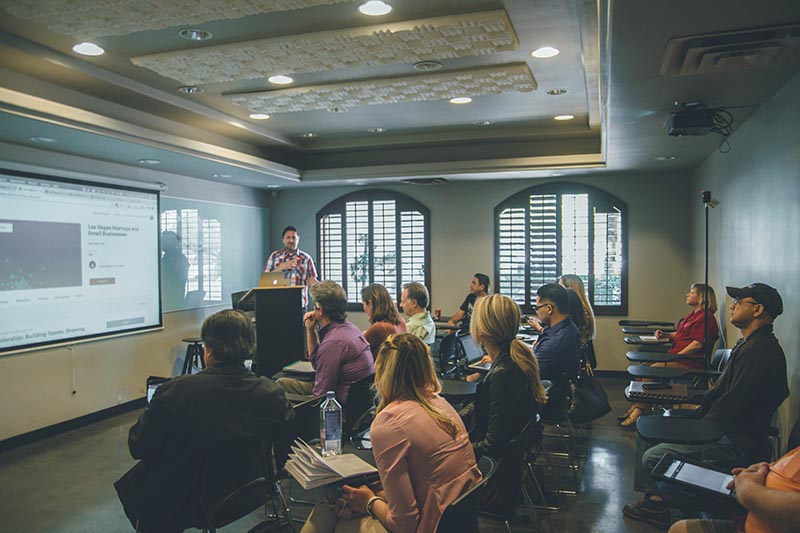
The Retention of Learning - The physical environment you are learning in
This is a quote from a person who attended WPI in the past... "Ok the seminars are huge (1000 fellow photographers in one room)"
1000 other photographers? Are you kidding me? And you think that's a conducive learning environment?!!! If it was I'd suggest that the Government of EVERY COUNTRY IN THE WORLD HAS GOT IT'S EDUCATION POLICY WRONG ALL THIS TIME. Instead of smaller class sizes, we should just go for bigger class sizes!!!!
Why do you think class sizes in schools are reducing? A teacher - child ratio of 1-15 is considered good; most classrooms now have teaching assistants to help this ratio.
How can one person possibly hope to train 1000 people effectively? You can't. That's not training session - it's a talk. It's an "I'll talk at you for 60 minutes" session and hope you take a tiny proportion away.
Bitchy comment coming... but if "you don't take anything away it's not my fault it's yours and maybe you need to come back on one of my workshops again." Yes - I've been told that previously when I questioned the method a famous photographer was using. (In other words I'm the dumb guy who spent £2.5k on a workshop and obviously need to spend another £2.5k coming back...)
Point to Note. This is where video really brings itself to the fore of training. You can stop a video where ever you like, go away and find out more info yourself, practise it, think about the topic ad then restart the video. Unfortunately, you can't ask the questions YOU find important on a video!
I could go on but I'm sure you get where I'm going with this.
So, what are the numbers?
More research is being done on this issue; however, anecdotal evidence would indicate the following:
90% of what they learn when they teach someone else/use immediately.
75% of what they learn when they practice what they learned.
50% of what they learn when engaged in a group discussion.
30% of what they learn when they see a demonstration.
20% of what they learn from audio-visual.
10% of what they learn when they’ve learned from reading.
5% of what they learn when they’ve learned from lecture.
So look at the points over, especially the one with 1000 photographers in a room. That's not training. It's a lecture. And you walk away with maybe 5%? Let's call it 10% because you are really motivated to learn. You paid £2k to go to a WPPI lecture and you will retain / learn 10% from one session. Does that sound like a good Return on Investment to you? Stay at home and buy the book - you get 10% a lot more cheaply. Stay at home and buy a video and a book - you'll get 30%-40%.
But it's all about the experience I hear you scream!!!!!
Yes. I'd agree with you. I'm sure attending WPPI is an amazing experience. But we're not talking about an experience here - were talking about training and learning. We're talking about making sure you can afford that £2k and get something back rather than a hangover. Different things.
Meanwhile back in the real world...
Back to the real world now, though. You have seen the advert for a 5-day workshop delivered by a world class photographer in a superb location. The advert says you will learn "How to photograph and edit a real wedding", "How to market yourself", "How to sell more albums", etc etc.
Take a step back. Look at the PR spin. What are the learning Aims, Objectives and Outcomes? How many people will be on the workshop? Is the photographer a trained trainer? Are you paying more for a stunning location? (or to put it another way are you paying through the nose for an experience...) Can you put into practice more than 85% of what the workshop is about?
They should be just some of the things you ask yourself.
Part 3 - Keeping your accountant happy or Return on Investment and How to Measure It.



0 Comments