


The York Tea Convention of 1758
A Completely Accurate Historical Account (According to Absolutely Nobody)
In the summer of 1758, when Britain still believed most illnesses could be cured with gravy and shouting, an extraordinary gathering took place in the ancient city of York. Historians have long denied the existence of this event, largely because it never happened, but according to deeply unreliable local legend, this was the moment the modern rules of tea were decided forever.
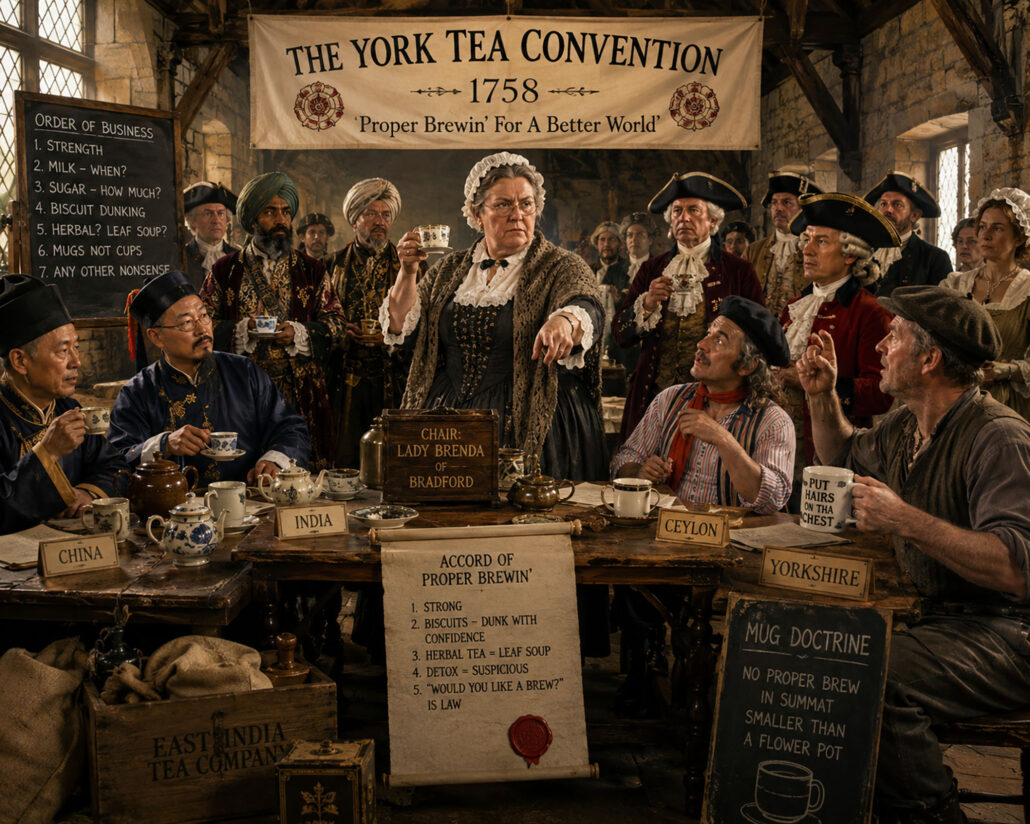
The event became known as The York Tea Convention of 1758 .
Delegates arrived from every corner of the tea-growing world. Chinese tea masters crossed oceans in great trading vessels. Indian growers travelled for months with crates of Assam. Ceylonese traders brought carefully wrapped leaves protected by silk and spices. A nervous Frenchman arrived by mistake thinking it was a wine fair and was politely escorted out by several Yorkshire grandmothers armed with stern looks and fruitcake.
But the true power at the convention did not belong to the growers.
No.
It belonged to Yorkshire folk.
The York Tea Convention of 1758
The opening ceremony took place in a draughty hall above a pie merchant’s shop near the Shambles. Witnesses described the atmosphere as “tense but heavily buttered.” At the centre of the room sat the High Council of Yorkshire Tea Drinkers: twelve men, six women, and one terrifying auntie called Brenda who could silence a room merely by adjusting her cardigan around her unfeasibly large bosom.
The chairperson, Sir Geoffrey Butterworth of Harrogate, struck the ceremonial biscuit tin with a spoon, bringing the crowded room to order.
“Right then,” he announced. “Let’s sort tea out properly.”
The first debate lasted three days.
The Milk Question
Tea growers from China argued that fine tea should be enjoyed pure, without milk, so the delicate flavour notes could be appreciated.
Yorkshire representatives listened carefully. And proceed to disagree entirely. They knew they needed to support the dairy farmers of South Yorkshire, and thus tea SHOULD have milk innit.
Then a man called Colin from Leeds asked, “Aye, but what if it tastes weak?”
This caused immediate uproar.
Several delegates fainted when Yorkshire miners demonstrated how they made tea underground using water “hot enough to melt scaffolding.” One Japanese tea master reportedly burst into tears after witnessing a Hull dockworker add four sugars and describe the result as “a decent start.”
The Convention nearly collapsed during what historians now call The Great Milk Incident.
The Indian delegation insisted that milk should be added after the tea had brewed.
The Yorkshire delegation insisted milk should be added “whenever tha’ feels like it.”
At one point, two elderly women from Whitby physically removed a Portuguese diplomat for microwaving water.
Editor's Note - The 'Old Portuguese' for reheating was, in fact ", microwave". Not many people know that.
Peace was eventually restored after the signing of the historic Accord of Proper Brewin’, which established the following international rules:
- Tea must be strong enough to “put hairs on tha’ chest.”
- A biscuit may be dunked, but only by someone experienced enough to judge structural integrity.
- Herbal tea was officially classified as “leaf soup.”
- Any tea described as “detoxifying” would be met with suspicion.
- The phrase “Would you like a brew?” became legally binding in Yorkshire.
The second week of the convention focused on serving standards.
A fierce dispute broke out when aristocrats from London proposed serving tea in tiny porcelain cups “for elegance.”
This proposal was rejected immediately by Yorkshire delegates, who unveiled what became known as The Mug Doctrine.
“Tha’ can’t have a proper brew in summat smaller than a flower pot,” declared Brenda.
The motion passed unanimously after a brief fistfight with the Duke of Porcelain.
There were also cultural exchanges. Tea growers taught Yorkshire folk about harvesting techniques, drying methods, and regional flavour profiles.
Yorkshire folk taught everyone else how to stand in silence staring out of a window while drinking tea and quietly judging weather.
One account tells of a Tibetan monk who achieved enlightenment after spending forty minutes in Barnsley listening to two pensioners discuss fence panels whilst sipping on the same tea for days on end.
The convention’s greatest crisis came during the final banquet.
A young servant accidentally served Earl Grey to a table of Yorkshire coal workers without warning them it contained bergamot.
Witnesses described the aftermath as “biblical.”
One miner reportedly stood up, sniffed the cup suspiciously, and shouted:
“Who’s put perfume in me tea?!”
Three chairs were overturned.
A clarinet was broken.
The Frenchman somehow got blamed again.
To calm tensions, Sir Geoffrey proposed the creation of a universal standard brew known simply as Builder’s Tea — powerful enough to revive the dead, strip wallpaper, and sustain a man through twelve hours of rain and disappointment.
The growers reluctantly agreed.
And so, according to absolutely no reputable historian whatsoever, the York Tea Convention of 1758 shaped tea culture forever.
To this day, it is said that somewhere beneath York Minster lies the original treaty, stained with biscuit crumbs and bearing the immortal closing words of Brenda herself:
“If tha’ can see bottom of cup, it needs another teabag.”
And thus peace was achieved.
Mostly because everyone stopped arguing and put kettle on.
Editor's Note - Builders Tea can also be referred to as NATO Standard Tea
Addendum to the York Tea Convention Archives
The Andrew Miller Exemption
Scholars of the entirely fictional York Tea Convention often overlook a lesser-known amendment added many years later to the original treaty. Hidden in the margins of the Fourth Brewing Charter, between notes regarding biscuit durability and a sketch of a suspiciously angry teapot, lies what became known as:
The Andrew Miller Exemption
The amendment itself was reportedly introduced after delegates encountered one Andrew Miller of Andrew Miller Photography, whose remarkable dedication to sarcastic dad jokes had already become legendary despite him not being born for another two centuries.
According to folklore, a temporal disturbance occurred during a wedding fair in North Yorkshire sometime around 2024, causing Andrew to accidentally wander backwards through time while carrying three cameras, two lenses, and “just one more bag that definitely contains important gear.”
Editor's Note - The Heart of Gold played a MAJOR part in this, by the way,
The people of 1758 were initially alarmed.
Witnesses described him as:
- “A wandering image wizard.”
- “Possibly Dutch, but definitely not French,”
- “Carrying enough equipment to invade Belgium.”
However, after only twenty minutes in his company, the Convention delegates recognised his extraordinary abilities:
- The capacity to produce a sarcastic remark within three seconds of any statement.
- The supernatural endurance required to photograph weddings for twelve continuous hours, fuelled only by mild disappointment and vending machine snacks.
- The uncontrollable urge to say phrases such as:“I’m just here for the candid shots.”and“Smile… or don’t. I photograph misery beautifully too.”
Most impressive of all was his legendary mastery of the Dad Joke Offensive, a conversational technique so powerful that several tea masters reportedly walked into walls trying to escape it.
One surviving fictional account records the following exchange:
A delegate asked:
“How do you take your tea?”
Andrew replied:
“Ideally nowhere near a teabag.”
Editor's Note - Actually, he didn't say that at all. It was his mate Nigel.
The room fell silent.
Several Yorkshire elders crossed themselves.
One man from Bradford fainted directly into a sponge cake.
For the first time in Convention history, the High Council faced a problem they could not solve.
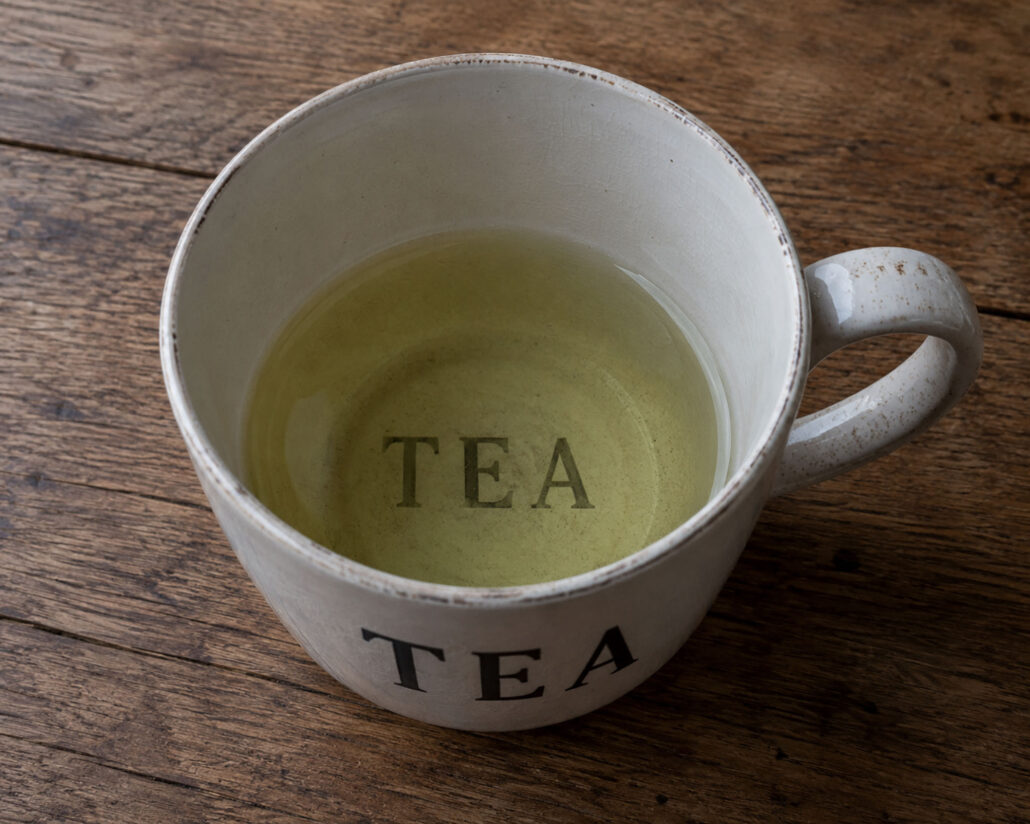
Andrew Miller’s tea preference was, by Yorkshire standards, considered deeply troubling:
- Really, really, really weak.
- No sugar.
- No milk.
In fact, observers noted the beverage resembled “hot regret with a faint memory of leaves.”
Under normal Convention law, this would have resulted in immediate confiscation of brewing privileges and possibly exile to the south of England.
But the Council hesitated.
Brenda herself studied the cup carefully before finally declaring:
“Well… it’s clearly wrong… but lad’s suffered enough photographing weddings in rain. Let him have it.”
Thus, by unanimous vote, the York Tea Convention of 1758 granted the first and only official exemption in tea history.
The decree stated:
“Andrew Miller may consume tea in whatever horrifying form he chooses, provided he continues supplying quality sarcasm, excellent photographs, and occasional dry commentary during group shots.”
To this day, the amendment remains unique. No other exemption has ever been granted.
Mainly because the Yorkshire delegation feared anyone else attempting such weak tea would have to be fought immediately.


0 Comments